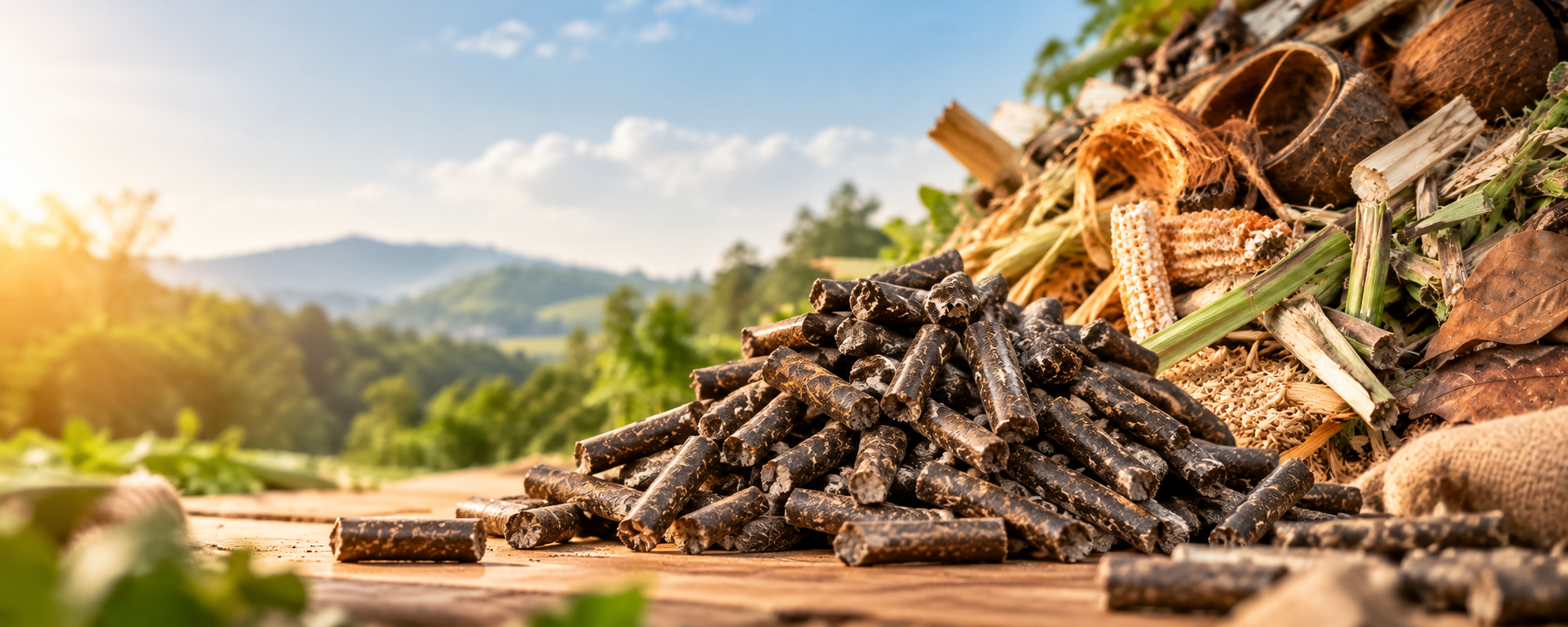
BIOMASS TO ENERGY
Developing solutions that convert biomass waste and resources into fuels and thermal energy, tailored to material characteristics and specific project requirements.
OUR APPROACH
Agricultural residues, wood processing waste, and various other biomass resources have energy potential that can be recovered when properly prepared and utilized.
RePyra helps develop biomass utilization pathways based on material type, fuel characteristics, resource availability, energy requirements, and implementation scale.
BIOMASS POTENTIAL
Every biomass resource has different characteristics. Material type, particle size, moisture content, ash content, density, and combustion behavior are important considerations when determining the most suitable utilization pathway.
01
Various residues from agricultural activities have the potential to be processed and utilized as biomass energy resources.
02
Sawdust, wood offcuts, and other wood processing residues can be developed into solid fuels according to their characteristics and intended applications.
03
Other biomass resources can be evaluated based on their material characteristics and potential for utilization as energy sources.
OUR SOLUTION APPROACH
Biomass energy solutions do not always require the same approach. Material conditions, volume, supply continuity, location, and energy requirements determine how biomass should be prepared and utilized.
RePyra evaluates biomass resources and user requirements to develop suitable utilization pathways, from material preparation to its use as a thermal energy source.
01 — SOURCE
Biomass
02 — PREPARATION
Processing & Formulation
03 — FUEL
Solid Biomass Fuel
04 — UTILIZATION
Thermal Energy
UTILIZATION PATHWAYS
The form of biomass fuel depends on material characteristics and the requirements of the energy system. In certain conditions, biomass can be utilized after simple preparation, while in other applications, densification into pellets can provide a more uniform and practical fuel form.
01
Biomass can be prepared by adjusting particle size, moisture content, and material conditions to suit specific combustion systems.
02
Densifying biomass into pellets can produce a more uniform, compact, and practical fuel for handling and use.
03
Certain biomass resources can be developed through formulation to achieve fuel characteristics better suited to specific energy requirements.
REPYRA IMPLEMENTATION
One of the approaches developed by RePyra involves processing and formulating biomass into PyraMAX, a research-developed pellet fuel designed to provide effective and consistent thermal energy.
01
Biomass
Material resources with energy potential.
02
Formulation
Fuel preparation and composition development.
03
PyraMAX
Formulated biomass pellets as an alternative fuel.
04
Thermal Energy
Utilized through the Biomass Stove or other suitable combustion systems.
APPLICATIONS
Biomass utilization can be developed according to available local material resources and the energy requirements of each user.
01
Utilizing biomass fuels for productive activities that require thermal energy.
02
Developing local biomass resources into energy that can be utilized by communities.
03
Exploring the use of biomass as a thermal energy source to support specific industrial processes.
BIOMASS WASTE → ENERGY
Tell us about your biomass type, available volume, and energy requirements. RePyra can help evaluate its utilization potential and develop a suitable approach.
