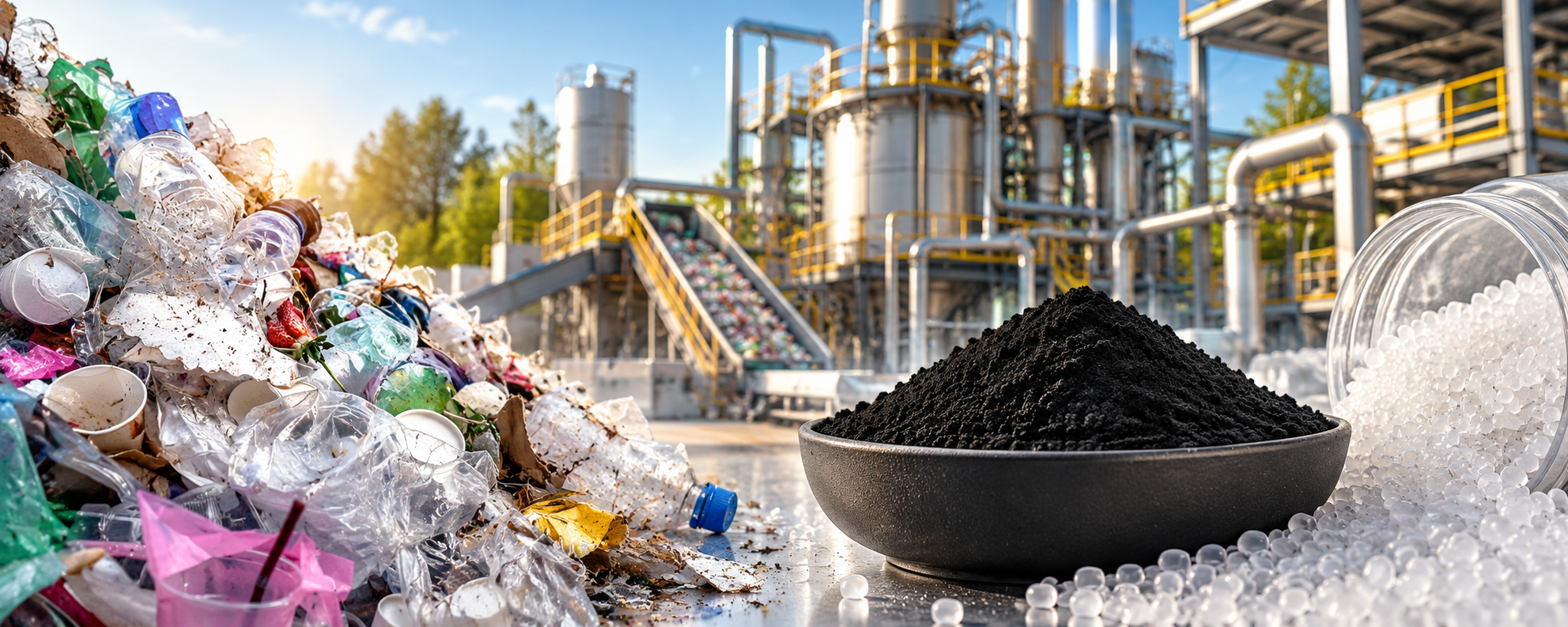
WASTE TO MATERIAL
Developing pathways to transform various carbon-containing waste resources into Carbon Black, a valuable material with potential applications across industrial sectors.
OUR APPROACH
Various waste streams still contain carbon that has the potential to be developed into higher-value materials.
RePyra explores and develops conversion pathways for different waste resources into carbon-based feedstocks that can subsequently be processed into Carbon Black, depending on feedstock characteristics and intended applications.
CARBON SOURCES
Carbon Black production pathways can be developed using various alternative carbon sources. Each feedstock requires its own evaluation and conversion approach before it can be utilized.
01
Certain types of plastic waste can be converted into hydrocarbon products, which may then be developed as carbon sources for Carbon Black production.
02
Biomass residues can be converted into carbon-based intermediate products with potential for further development into Carbon Black.
03
Vegetable oils, processing residues, and other waste-derived hydrocarbon resources can be evaluated as alternative carbon sources.
*Feedstock suitability depends on material characteristics, composition, condition, and the specifications of the intended product.
OUR SOLUTION APPROACH
Every waste stream has a different composition and set of characteristics. Therefore, developing Carbon Black does not always involve the same conversion approach.
RePyra considers the entire utilization pathway, from identifying carbon sources and selecting conversion methods to defining the desired material characteristics and potential Carbon Black applications.
01 — SOURCE
Waste-Based Carbon Source
02 — CONVERSION
Carbon-Rich Feedstock
03 — MATERIAL DEVELOPMENT
Carbon Black
04 — UTILIZATION
Industrial Material
WASTE-BASED CARBON BLACK
Conventional Carbon Black production relies heavily on fossil-derived hydrocarbons. Waste-based approaches create opportunities to replace part of these resources with materials recovered from waste streams and alternative sources.
01
Creating pathways to transform waste into materials with higher potential value.
02
Exploring alternative carbon sources to reduce dependence on fossil-based feedstocks.
03
Recovering the carbon value of discarded materials and bringing it into new utilization pathways.
MATERIAL DEVELOPMENT
The characteristics of Carbon Black determine how the material can be used. Therefore, development does not end simply when a black-colored material is produced.
Feedstock sources and conversion conditions can influence product characteristics. Further evaluation and development are necessary to align the material with its intended application requirements.
Characteristics
Understanding the properties of the resulting material.
Consistency
Developing processes toward consistent results.
Applications
Aligning material development with intended uses.
POTENTIAL APPLICATIONS
Carbon Black is used across various industrial sectors. Its application potential depends on the characteristics and specifications of the material being developed.
01
Carbon Black is an important material used in various rubber-based applications.
02
Carbon Black has potential applications as a carbon-based material in a range of plastic and polymer products.
03
The characteristics of Carbon Black also offer potential applications in coatings, pigments, and other materials.
*The suitability of Carbon Black for specific applications depends on the material characteristics and product specifications required by each industry.
WASTE → CARBON BLACK
Tell us about your material type, characteristics, and intended applications. RePyra can help explore its potential and development pathways toward Carbon Black.
